
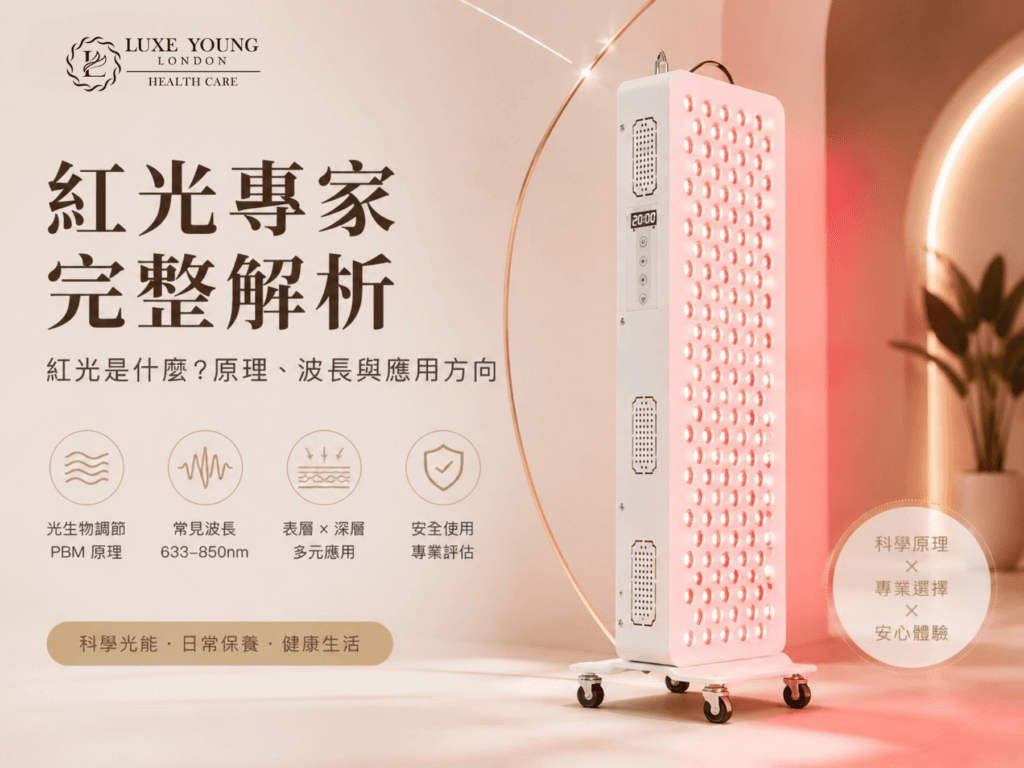
近年紅光面罩、光能艙&全身紅光設備愈來愈常見,但「看起來會發紅光」不代表設備、波長與用途都相同。真正理解紅光,需要同時看光譜、能量、距離、時間、使用頻率與適用情境。這也是為什麼專業服務不能只說「照多久」,而要先說明使用目的、設備條件與安全邊界。
Red Light Is More Than Just a Red Lamp: Understanding Photobiomodulation PBM
Red and near-infrared light, under specific wavelengths and energy conditions, may trigger non-thermal biological responses in cells and tissues. This field of research is commonly known as photobiomodulation (PBM).Photobiomodulation, PBM), formerly also known as low-level laser therapy (LLLT) or low-level light therapy (LLLT).
PBM It Does Not Work by Heating Tissue with High Temperatures. FDA Descriptions of low-level light therapy indicate that these procedures typically use very low doses of visible light and are theoretically intended to produce non-thermal effects by influencing cellular activity. However, actual outcomes depend heavily on device specifications and treatment parameters. Not all red light devices should be considered equivalent or provide the same type of service.
What Are the Differences Between Common Wavelengths?
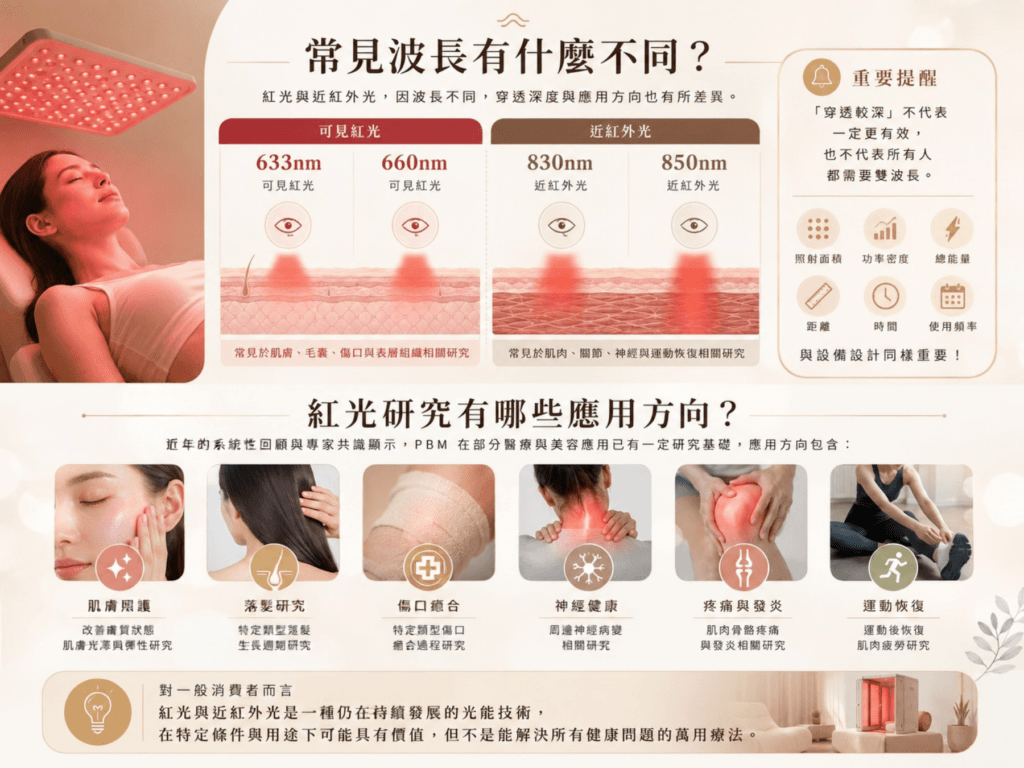
633nm & 660nm It belongs to the visible red light spectrum and is commonly studied in relation to the skin, hair follicles, wounds, and superficial tissues.830nm、850nm It belongs to the near-infrared (NIR) spectrum. It is difficult to see with the naked eye and generally has deeper penetration characteristics than visible red light, making it commonly studied in areas related to muscles, joints, nerves, and exercise recovery.
However, “deeper penetration” does not necessarily mean it is more effective, nor does it mean that everyone requires dual wavelengths. Wavelength is only one factor among many. Irradiation area, power density, total energy dose, distance, exposure time, frequency of use, and device design are equally important considerations.
What Are the Research Applications of Red Light Therapy?
Recent systematic reviews and expert consensus statements indicate thatPBM 在部分醫療與美容應用已有一定研究基礎,例如特定類型的傷口、落髮、周邊神經病變、放射性皮膚炎及部分疼痛情境。然而,不同適應症的證據強度並不一致,研究參數也常有差異。
For consumers, a more balanced understanding is that red and near-infrared light represent an evolving light-based technology. Under specific conditions and applications, it may offer potential value, but it is not a universal therapy capable of solving every health concern.
Why Choosing a Red Light Therapy Expert Matters More Than Just Looking at Equipment Photos
A professional red light therapy service should be able to clearly explain: What wavelengths are used? What are the device’s energy output and irradiation methods? Which lifestyle situations may be suitable? What are the limitations and precautions? Can the approach be adjusted according to individual conditions? If a provider only emphasizes “brighter, longer, and more effective,” it should be approached with caution.
LUXE YOUNG Health Care Red light therapy is positioned as part of daily light-based wellness and health lifestyle services, while distinguishing between seated red light therapy, skin-focused light exposure, and different wavelength applications. Before each session, individual needs and specific conditions are reviewed to avoid presenting red light as a direct medical treatment for diseases.
Who Should Consult a Professional Before Using Red Light Therapy?
People with photosensitive conditions, those taking medications that may increase light sensitivity, individuals undergoing cancer treatment, people with implanted medical devices, active infections, unhealed wounds, or those who are pregnant should first consult a healthcare professional for evaluation. Eye protection should also be used appropriately according to the device’s guidelines.
Although low-level light therapy generally has a relatively limited risk profile, it may still cause localized sensitivity, skin reactions, discomfort, burns, or issues related to equipment malfunction. Safety should not rely solely on the statement that “red light is gentle,” but requires appropriate devices, treatment parameters, and proper operating procedures.
Yishii A Friendly Reminder
Red light is not simply “brighter is better,” and longer exposure does not always mean better results. Wavelength, energy level, distance, duration, and usage method should all be evaluated together.
常見問題 FAQ
Q1:每天都可以照紅光嗎?
依設備設計、波長、能量及個人狀況不同,建議依專業建議安排使用頻率。
Q2:660nm 和 850nm 哪個比較好?
沒有絕對哪一種比較好。
兩者具有不同穿透特性,適合的應用方向也有所不同。
Q3:紅光照越久效果越好嗎?
不是。
PBM 重視的是適當的波長、能量與照射參數,而非照射時間越長越好。
Q4:紅光療法可以治療疾病嗎?
本文提供的是健康管理與生活教育資訊,不作為疾病診斷、治療或醫療建議。
Conclusion
真正的紅光專業,不是把所有研究結果都包裝成療效,而是清楚說明哪些方向已有研究基礎、哪些仍在持續發展,以及哪些情況需要先接受專業評估。
紅光可以是健康管理的一部分,但健康並非只靠單一設備就能改善。充足睡眠、均衡飲食、規律運動、壓力管理與定期健康檢測,同樣是維持良好生活品質的重要基礎。
LUXE YOUNG Health Care 希望透過專業健康管理服務,協助每位重視健康的人,更了解自己的身體狀態,建立適合自己的健康生活方式。
Learn More 633nm、660nm & 850nm Differences between various light therapy technologies, including seated red light therapy and other light-based devices, can be explained through an in-store consultation and experience session.
延伸閱讀建議
References
- U.S. Food and Drug Administration. Photobiomodulation Devices – Draft Guidance for 510(k) Submissions. 2023.
- U.S. Food and Drug Administration. Non-Invasive Body Contouring Technologies: Photobiomodulation (Low-Level Light).
- Siegel DM, et al. Evidence-based consensus on the clinical application of photobiomodulation. J Am Acad Dermatol. 2025. PMID: 40253006.
- Glass GE. Photobiomodulation: A systematic review of oncologic safety for aesthetic skin rejuvenation. Aesthetic Plast Surg. 2023. PMID: 36722207.
Health Information Disclaimer: This article provides general health management and wellness education information and is not intended as a diagnosis, treatment, or medical advice for any disease.LUXE YOUNG Health Care As a health management and assessment planning integration provider, we coordinate health management services and related assessments. Services involving medical testing, disease diagnosis, or treatment are performed by qualified partner medical institutions or testing organizations. If you experience persistent discomfort, acute symptoms, or are currently receiving treatment, please consult a qualified healthcare professional.