

Near-Infrared Light Exposure May Help Support Skin Inflammation Management
Photobiomodulation (PBM) (Photobiomodulation; PBM) is a method that uses visible light or near-infrared light (NIR)NIR;Wavelengths700–1100 nm) is a method that uses specific light wavelengths to stimulate cellular functions. It has been widely studied and applied in medical and wellness fields, with research exploring its potential roles in areas such as wound healing, pain management, and inflammation regulation.
In biological tissues, the absorption and penetration of light depend on the interaction between the wavelength of light and the components of the tissue. Simply put,600Nanometer(nm)Wavelengths below this range are more strongly absorbed by tissue components such as hemoglobin, while wavelengths above1100 nmNanometer (nm) light(in/Far-infrared light (FIR))is absorbed by water.700-1100 nmis located within the tissue optical window of absorption (tissue optical window)Therefore, near-infrared light generally has greater tissue penetration capability. Near-infrared light can penetrate the skin to depths of up to5毫米 (mm)and can reach subcutaneous tissues and even superficial bone structures, potentially influencing deeper and more complex cellular interactions, including immune responses.
Macrophages can, through their M1/M2 polarization changes, guide immune responses.: M1drive inflammatory responses,M2lead to either pro-inflammatory or anti-inflammatory responses. In this study, we elucidated the molecular mechanisms by which near-infrared light influences macrophages. Through proteomic analysis, we found that near-infrared light irradiation enhanced citrate synthase activity within the mitochondrial respiratory chain.CS) expression, rather than being triggered by heat. This change was caused by epigenetic regulation induced by near-infrared light. (epigenetic regulation; a type of gene activation that can persist for at least several weeks/mechanism). This resulted in the expression of inflammatoryM1Macrophage polarization towardM2polarization, ultimately leading toTCellular release TGF-β1andTGF-β1is a representative protein associated with anti-inflammatory responses and tissue repair. Therefore, it was suggested that near-infrared light may have potential anti-inflammatory effects.
These findings were further validated in mouse experiments. In a mouse model of induced skin inflammation, we confirmed that near-infrared irradiation (Energy60 J/cm2After a single irradiation session,) reduced the expression of inflammatoryM1cell numbers and reduced inflammatory factors. TNF-α, and increased anti-inflammatoryCCL22/TGF-β1. In mice treated with near-infrared irradiation, inflammatory symptoms such as redness and swelling were restored to levels close to those observed without inflammation.
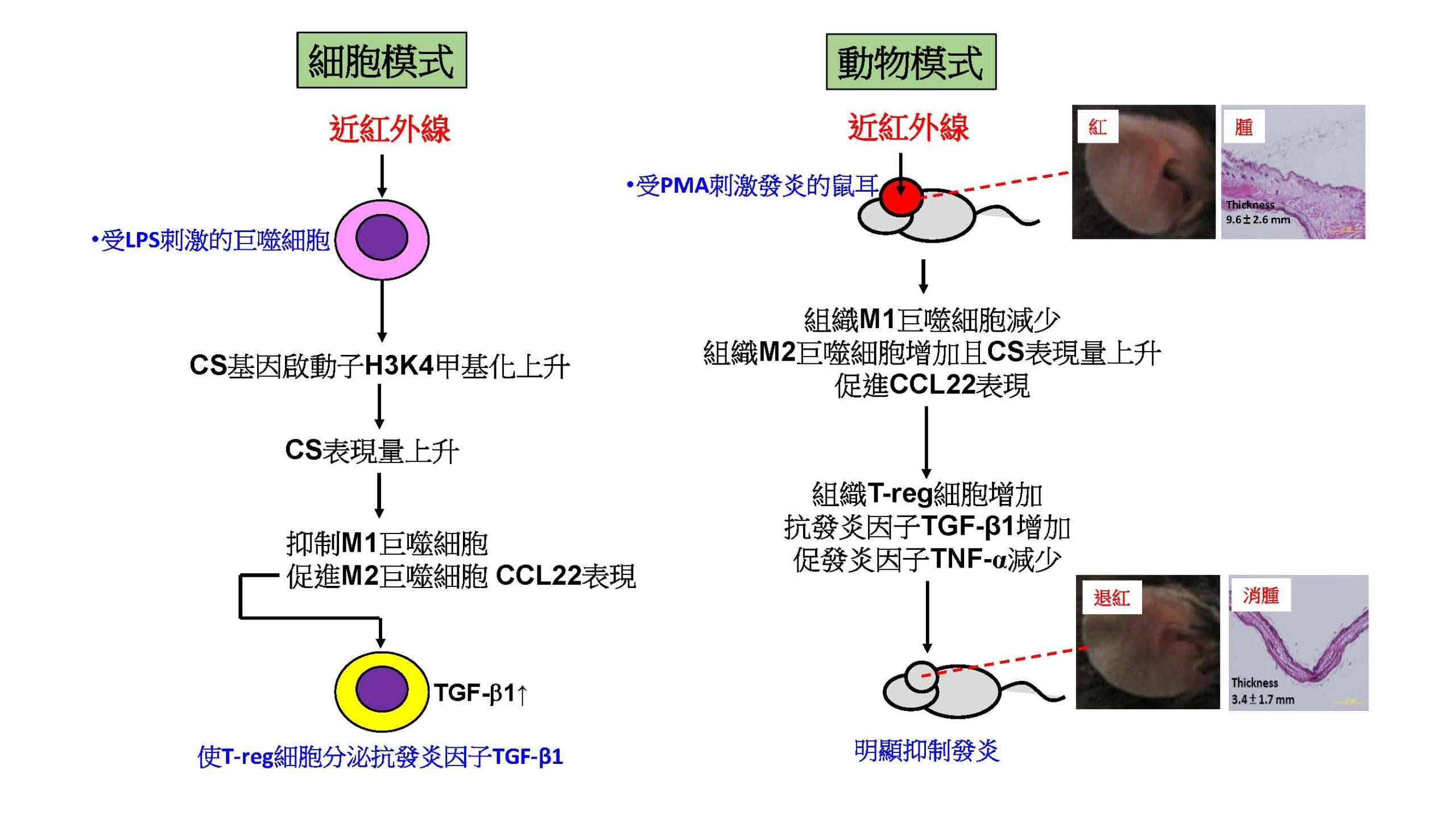
1.revealed the core mechanism by which near-infrared light influences immune responses (表觀基因修飾)
2.clarified the mechanism underlying the anti-inflammatory effects of near-infrared light (Release TGF-β1)
3.providing a theoretical basis for the clinical application of near-infrared light
【Research Team】
Team Members:
Professor Wei-Ting Liao, Professor Koji Yuki
Representative Institution: Department of Biotechnology, Kaohsiung Medical University
Team Introduction: Professor Wei-Ting Liao’s primary research focuses on the regulation of macrophages in cancer and inflammatory diseases. His team reconstructs these regulatory processes in vitro using tissue microenvironment models to evaluate potential prevention and therapeutic strategies.
Research CollaborationEmail: wtliao@kmu.edu.tw
【Publication Information】
Publication Source:J Invest Dermatol. 2021 Aug; 141(8): 2056-2066.e10
全文下載:https://www.sciencedirect.com/science/article/pii/S0022202X21001573